FLAC is the most popular lossless codec, lossless meanings no audio quality is lost whilst compressing (unlike lossy codecs such as mp3 which throw audio data away). Audio compressed with a lossless codec will
be decoded identical to the source, think of it as zip for audio. All lossless codecs compress around 2:1 at best, a 3 minute audio track will be around 18 MB.
Compression Options
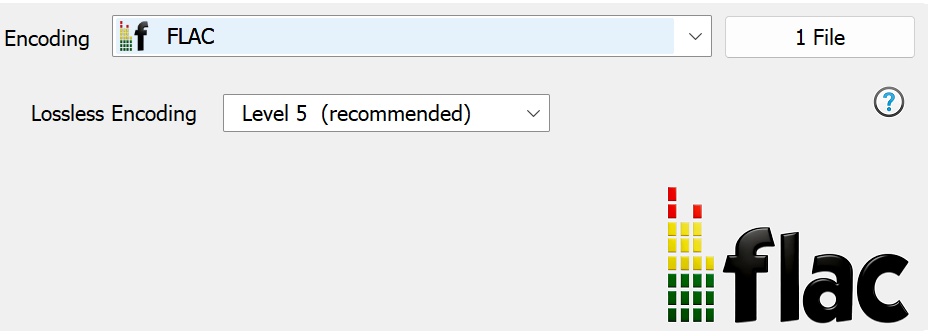
Being a lossless codec there is only one option to set when compressing to FLAC: Compression affects how much effort goes into compressing the audio.
All compression modes give the same decoded audio (it is lossless after all), the higher compression levels will give a small % file size saving, but will require more time to compress and decompress.
Compression Level 0 requires the least compression time, whilst Compression Level 8 the most. Uncompressed is a special compression mode with stores 16 bit audio in an uncompressed state.
Codec Background
FLAC is a acronym for Free Lossless Audio Codec, and is a popular open source cross-platform codec. FLAC falls under the Ogg banner (Vorbis, Speex and FLAC). Primarily developed by Josh Coalson.
FLAC supports Vorbis Comments, these are present at the beginning of the file and allow Unicode tagging. Vorbis Comments are not limited to fixed fields, but a lack of standardized extended tag values (ratings, etc) limit Vorbis Comments.
Terminology
Encoding: compress and write audio track, Decoding: uncompress and read the track, ID Tags: meta data such as artist & album are embedded inside the audio file, Lossless: compression without audio quality loss, Lossy: audio quality is sacrificed (how much depends on bitrate and codec used) to achieve smaller files, Gapless: allows the decoder to decode audio stream without gaps (silence).