dBpoweramp Music Converter { Help Index > DSD Codec }
DSD (Direct Stream Digital) the audio format used for Super Audio CDs (SACD). This codec is able to decode .dff (DSD Interchange File Format) and .dsf files, .dsf supports ID Tags whereas .dff does not.
The DSD encoder encodes to .dsf (with ID Tags).
DSD is an unusual format in that it used 1 bit samples with a very high sample rate: 2.8 MHz DSD64, or 5.6 MHz DSD128, 11.2 MHz DSD256, 22.4 MHz DSD512. DSD files are normally played directly by a compatible DAC.
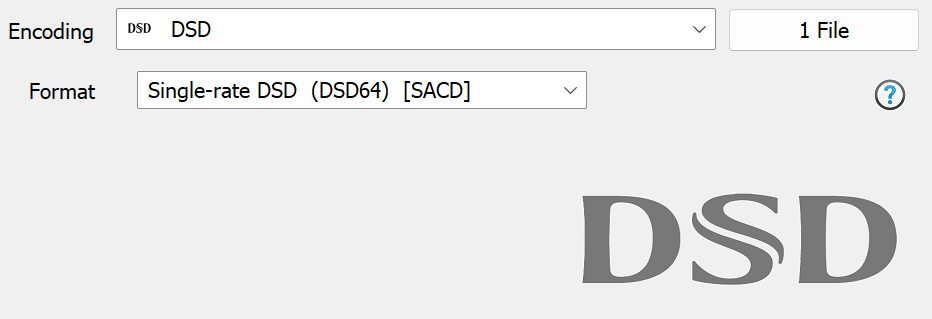
Format sets the DSD sample rate, from DSD256 to DSD2048, which are stupidly large files.
Codec Background
Direct Stream Digital (DSD) is a high-resolution, uncompressed audio format that represents sound using a 1-bit bitstream sampled at extremely high frequencies. Originally developed by Sony and Philips for archival purposes and later the Super Audio CD (SACD), it differs fundamentally from the standard Pulse Code Modulation (PCM) used in WAV, FLAC, and CDs.
DSD uses Pulse Density Modulation (PDM). Instead of measuring the absolute amplitude of a signal at each sample (as PCM does), DSD records whether the signal is increasing or decreasing relative to the previous sample:
"1" indicates the signal is rising.
"0" indicates the signal is falling.
A rapid toggle between 0 and 1 represents a stable signal or silence.
Noise Shaping: Because 1-bit encoding is inherently noisy, DSD employs "noise shaping" to push quantization noise into inaudible ultrasonic frequencies (above 20 kHz), preserving a high dynamic range of approximately 120 dB in the audible band.
ID Tag Details
ID3v2 tags can be saved to .dsf files, allowing the full range id ID Tags including album art.
Advanced Options
Advanced options for this codec (dBpoweramp Control Center >> Audio Codecs):
DSD Decoder
DSD Processing: on decoding (converting from DSD) the DSD file can be either decoded to PCM, at a set sample rate, 24 bit, or embedded as DoP (DSD over PCM) within another
lossless format (such as wave or FLAC). The idea behind DoP, is that DSD can be passed untouched to a compatible DAC, the player and transport need not know about DSD, as it is passed as PCM.
Decoding Down Sampling: used only with Decode to PCM, be aware if choosing high sample rates that the audio will contain ultrasonics, that is why by default 96 KHz is chosen as anything above 48KHz is filterd.
Terminology
Encoding: compress and write audio track, Decoding: uncompress and read the track, ID Tags: meta data such as artist & album are embedded inside the audio file, Lossless: compression without audio quality loss, Lossy: audio quality is sacrificed (how much depends on bitrate and codec used) to achieve smaller files, Gapless: allows the decoder to decode audio stream without gaps (silence).